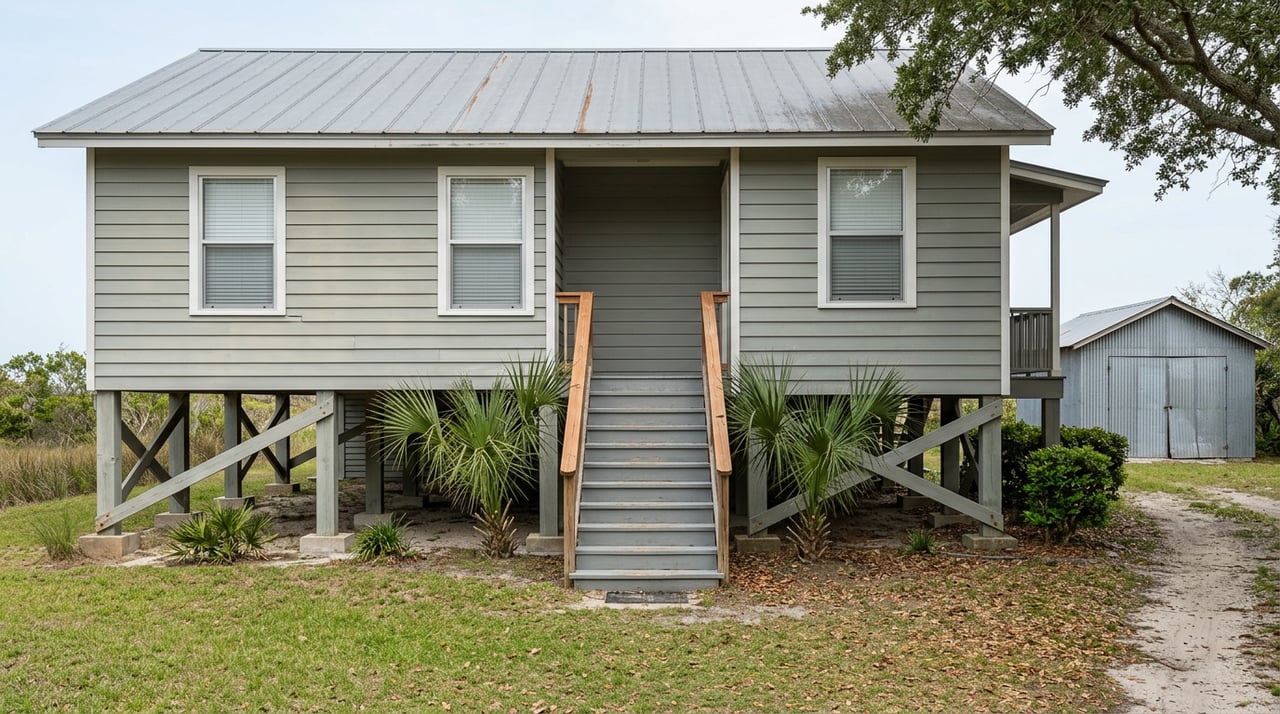
Rock Road runs about a mile off Alabama 188, past yards stacked with crab traps and shrimp nets hung out to dry, before it dead-ends near the water. This is where PJ Seafood sells shrimp brought in that morning, where Sea Pearl Seafood has been packing fresh and cooked seafood since 1966, and where, a short drive over on Archie Zirlott Road, H & M Seafood does the same. Keep driving and the smell of brine eventually gives way to something else: the sound of grinding steel and the sight of a shipyard that just announced the biggest expansion in its history.
Most descriptions of Coden stop at the first part. They mention the fishing boats, the quiet, the sense that not much has changed here in a hundred years. That version isn't wrong. It's just half the story, and the other half is worth knowing if you live here.
The waterfront shaped by a hurricane, a fire, and a hotel
Coden's history as a waterfront community has deep roots. The name itself comes from Coq d'Inde, French for turkey, shortened by English speakers over generations. Around 1900 the area was a genuine resort destination, and in 1907 cotton broker John Rolston built the three-story Rolston Hotel on 30 acres overlooking Portersville Bay after a hurricane the year before killed as many as 150 residents along this stretch of coast. For two decades, guests including Jefferson Davis and Booker T. Washington reportedly walked its grounds, and anglers pulled 200-pound tarpon from the water out front. Then in 1927 a malfunctioning fireplace burned the hotel to the ground, and Coden settled back into what it had always been underneath the resort years: a fishing and shrimping village.
That same stretch of shoreline is now Cedar Point Pier, long known as the welcome mat to Dauphin Island because it sits right at the base of the bridge on AL 193. The pier itself dates to the 1950s and stayed in the McRae family from 1986 until Mobile County purchased it in December 2021 using a $2.2 million state GOMESA grant. Alabama residents still fish there without a saltwater license, a rule the county kept in place through the 2022 reopening and every season since. The pier closed again in March 2025 for shoreline stabilization and accessibility upgrades, including a new ADA-compliant deck and updated parking, and reopened that October with free, 24-hour access.
None of that reads like a boomtown. It reads like a community carefully maintaining what it already had.
Ten seafood businesses on one short stretch of road
The seafood side of Coden backs up the quiet image just as well, at least on the surface. A single Yelp search for seafood markets near the 36523 zip code turns up ten separate businesses: Zirlott's Gulf Products, PJ Seafood, Bayou Seafood Company, Lartigue's Fresh Seafood Market, Sea Pearl Seafood, Aquila Seafood, Fresh Seafood Distributors, R&A Oyster, Coden Beach Oyster, and H & M Seafood. That's a dense cluster of working seafood retailers for an unincorporated community this size, and it points to an economy still built on boats coming home with a catch rather than trucks coming in with inventory.
Even the oyster side has kept modernizing quietly. Andy DePaola runs Depe's Oysters using a patented system called the Shellevator, which raises and lowers oyster cages through the water column so workers don't have to get in the water to tend them. It's a small, specific example of an old industry updating its methods without changing its character. Southbound Restaurant and Bar, a newer addition on the same stretch, has built a menu around exactly this supply chain, serving shrimp po'boys and low country boil made with seafood that traveled a few hundred yards, not a few hundred miles.
Everything so far supports the postcard version of Coden. The next part doesn't.
The number that changes the story
Master Boat Builders has operated out of Coden for more than 40 years, a family-owned shipyard now in its third generation. Three years ago the company employed roughly 200 people. In August 2025, it announced a $7.8 million investment to build a new fabrication shop and floating dry dock, a project expected to add 85 jobs and push the workforce past 300. That expansion was still coming online when the company went further. In December 2025, NBC 15 reported that Master Boat announced a second project: a $60 million shipyard build-out on a 20-acre site across Bayou Coden, adding 200 more jobs on top of a workforce that had already doubled to 400 employees in three years.
In the same NBC 15 report, CEO Garrett Rice said, "This would be the largest expansion we've ever had." The plan splits the company's footprint across the bayou, with commercial vessel work on one side and government contracts, chiefly Navy and Coast Guard business, on the other. Rice has been clear the yard isn't chasing the scale of tier-one builders like Austal or Ingalls. It doesn't need to. Going from roughly 200 employees to a projected 600 in a few years, inside a community without its own city hall, is a significant shift regardless of who the neighbors are.
The ripple reaches beyond Coden's boundary lines. Because the shipyard sits just outside Bayou La Batre's city limits but inside its police jurisdiction, Master Boat pays half the standard business license fee to that city, and Bayou La Batre's mayor has said those fees already cover roughly a third of the municipal budget. That revenue contributes to services the whole area relies on, even though Coden itself has no separate government to collect it.
What this actually looks like from the driveway
For anyone living along Rock Road, Shell Belt Road, or the bayou itself, this shows up in ordinary ways before it shows up in any headline. It's more trucks and welding trailers moving along the same roads that lead to the pier. It's job postings for shipfitters, pipefitters, and structural welders that a neighbor's kid might actually take, since Master Boat has added workforce training programs alongside the physical construction. It's a few more cars in the lot at Southbound on a Tuesday, and a little more foot traffic for the seafood markets that have always depended on local paychecks as much as local boats.
None of it changes what makes Coden recognizable: the free pier, the fresh catch, and a community shaped by its waterfront history. What's different is that the same working waterfront that built Coden's fishing identity a century ago is now building tugboats and government vessels for the whole Gulf Coast, at a scale most people driving past the seafood stands on Rock Road have no reason to know about yet.
If you've watched any of this up close, whether it's the pier's reopening, a new seafood counter, or a family member starting shift work at the shipyard, we'd like to hear what you're seeing. Coldwell Banker Smith Homes keeps a close eye on what's actually happening in communities like Coden, not just what shows up on a postcard. Reach out any time you want to talk about what's changing along this stretch of the bayou.
This article is general information, not legal, tax or financial advice. Consult a qualified professional about your situation.
